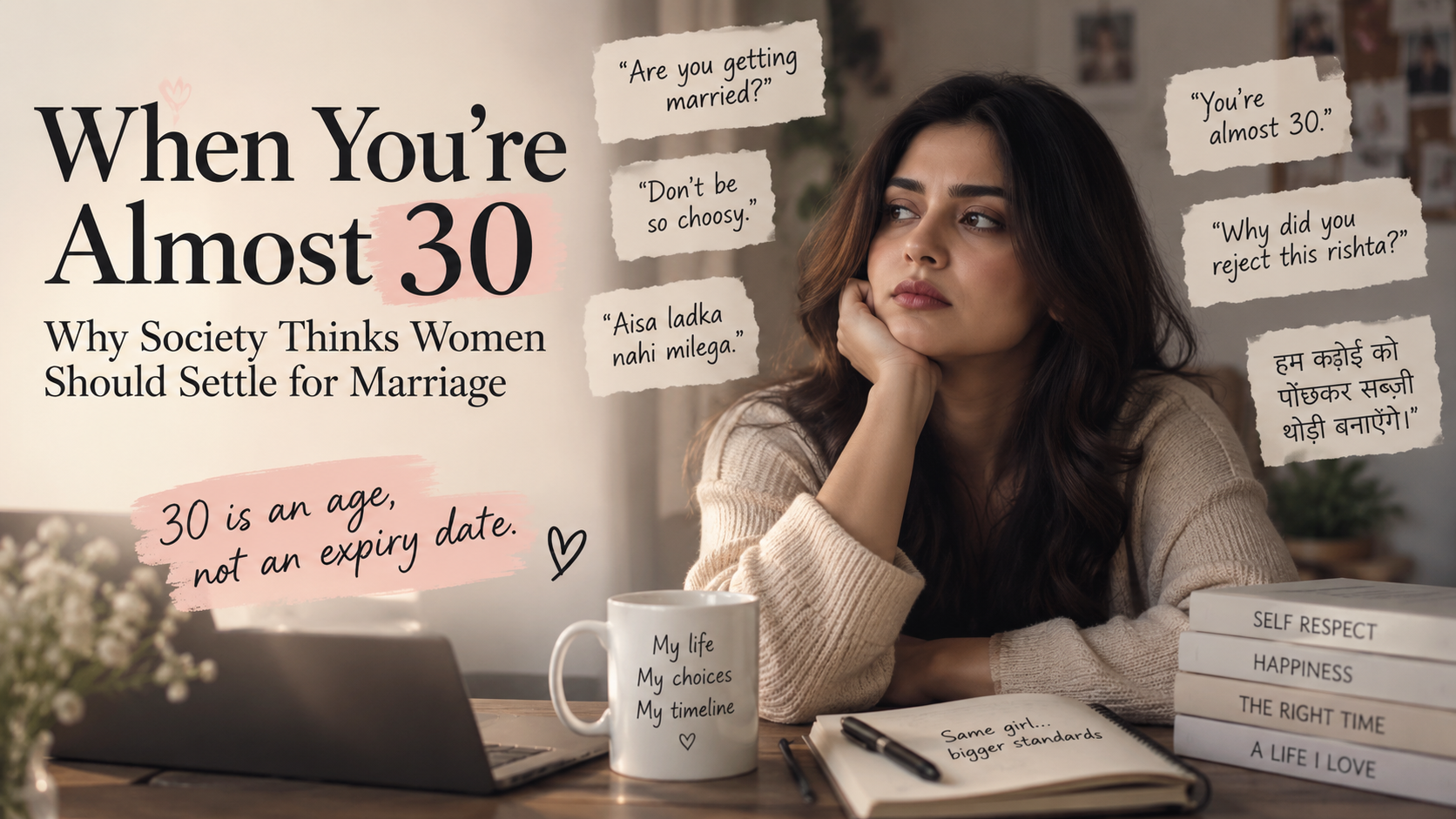
There is something very strange that happens when a woman starts approaching 30. Suddenly, everyone seems to have an opinion about her marriage, her choices, her standards, and even her future. The same people who never ask whether she is happy suddenly become extremely concerned about whether she is married.
“Are you getting married?”
“Why did you reject this rishta?”
“You’re almost 30.”
“Don’t be so choosy.”
“Aisa ladka nahi milega.”
Somehow, turning 30 becomes a deadline for women, as if a birthday can suddenly reduce their worth, their choices, or their chances of finding love.
A marriage proposal came for me recently. My parents and I discussed it together, and eventually, we decided that the match wasn’t right for me. There was no huge argument or dramatic reason behind it. We simply didn’t feel that it was the right person for me.
And honestly, I didn’t feel attracted to him either. He looked much younger to me, and I couldn’t imagine myself marrying him. I don’t think there is anything wrong with admitting that. Physical attraction matters in a marriage, just as emotional compatibility, personality, values, maturity, career, and expectations matter.
But apparently, saying no to a marriage proposal becomes a problem when you’re approaching 30.
Some of my immediate relatives started asking, “What’s wrong with the boy?” They told me that I wasn’t “too young” anymore to reject someone. They reminded me that I was getting older and suggested that I should simply say yes. They said I shouldn’t think too much about his age or looks and that I might not find someone like him again.
And then one of them said something that genuinely made me angry.
“We don’t ask the pan before cooking”.
The meaning behind the phrase was essentially that you cannot keep rejecting proposals forever. At some point, you have to accept what is available.
I remember thinking, are we talking about my life or cleaning a kitchen utensil?
Because that’s exactly what bothered me about the mentality behind that sentence. It made marriage sound like something a woman has to secure before her “useful” years are over. As if she is running out of options. As if she should be grateful that someone has shown interest and should stop asking questions before it becomes too late.
And I couldn’t help wondering: When did turning 30 become a reason for a woman to lower her standards?
Why does a woman’s age suddenly become more important than her happiness? Why is everyone concerned about whether she will get married, but so few people ask whether she will be happy with the person she marries?
Why is the conversation always about “Will you get another proposal?” instead of “Was this person right for you?”
There is also something else I’ve noticed. When a woman rejects a rishta, people immediately start looking for a hidden explanation.
Maybe she already has someone.
Maybe she is too choosy.
Maybe she thinks too highly of herself.
Maybe she doesn’t actually want marriage.
Maybe she is wasting her youth.
But what if the answer is much simpler?
Maybe she just didn’t like him.
Why is that so difficult to accept?
A woman doesn’t necessarily need a dramatic reason to reject a marriage proposal. She doesn’t have to be secretly in love with someone else. She doesn’t have to prove that the man was terrible. She doesn’t need a list of reasons long enough to defend herself in court.
Not wanting to marry someone is enough.
And yes, I know what people will say: “Looks aren’t everything.”
Of course they aren’t.
I’m not saying that a husband needs to look like a Bollywood actor. But pretending that attraction doesn’t matter at all is equally unrealistic. If you’re choosing someone to spend your life with, it is completely reasonable to want to feel some level of attraction and connection toward that person.
Marriage is not an arrangement where everyone else gets to decide that someone is “good enough” for you.
You are the one who has to live that life.
You are the one who will wake up next to that person. You are the one who will have conversations with him, disagree with him, build a home with him, share responsibilities with him, and experience the ordinary and difficult parts of life with him.
Your relatives will go home after giving their advice.
You will remain in the marriage.
So why shouldn’t your opinion matter the most?
What frustrates me even more is the way society treats women as they approach 30. There is this strange assumption that a woman’s value decreases with age. At 25, she can have preferences. At 27, she can still be selective. But as she gets closer to 30, people start getting nervous. And eventually, the advice becomes, “Don’t reject anyone. Just get married.”
But what exactly happens when a woman turns 30?
Does her intelligence disappear? Does her ability to make decisions disappear? Does she suddenly become incapable of knowing what she wants?
Of course not.
She simply gets older.
That’s all.
A woman turning 30 is not a woman becoming less valuable.
She is not expired. She is not leftover. She is not a burden waiting to be transferred from one family to another.
And marriage is not a clearance sale.
Yet sometimes the way people talk about marriage makes it sound exactly like one.
“Take this one.”
“Don’t reject him.”
“What if you don’t get another?”
“Your age is going.”
“You won’t get better options later.”
Why do we teach women to be afraid of being alone instead of teaching them to be afraid of being trapped in the wrong relationship?
Because there is a huge difference between being unmarried and being unhappy in a marriage.
I would rather be single at 30 than married to someone I knew I didn’t want to marry. I would rather answer uncomfortable questions from relatives than spend years wondering why I ignored my own instincts just to make everyone else happy.
And sometimes I think being the eldest daughter makes this pressure even more complicated. There is an invisible expectation that you should be mature, respectful, patient, and composed. You shouldn’t shout. You shouldn’t answer back. You shouldn’t create a scene. You should listen to everyone because they are older and supposedly know better.
So sometimes you sit quietly while someone says something that makes you furious.
You don’t respond, not because you agree, but because you know that if you finally lose your temper, everyone will remember your reaction and forget what provoked it.
There were definitely moments when I wanted to say, “I hope you give the same advice to your own daughter.”
But I didn’t.
Not because I didn’t have an answer. I simply don’t want to become cruel because someone else was insensitive.
I can be angry and still choose my words.
I can disagree without disrespecting someone.
And most importantly, I can say no without feeling guilty.
Maybe that’s the part society needs to understand.
A woman’s life does not become less important because she hasn’t married by 30. Her standards don’t become unreasonable because she wants compatibility. Her desire for attraction doesn’t make her shallow. Her independence doesn’t mean she has someone secretly waiting for her. And rejecting one marriage proposal does not mean she is rejecting marriage forever.
Maybe she is simply waiting for the right person.
Maybe she hasn’t met him yet.
Maybe she would rather wait than settle.
And maybe that’s okay.
Because marriage is not a race against age.
It is a decision about the person you want beside you for years, perhaps decades, of your life. That decision deserves thought, honesty, attraction, compatibility, and most importantly your consent.
So yes, I’m approaching 30.
Maybe I’ll get married soon. Maybe I won’t. Maybe the next proposal will be right for me, or maybe it will take several more before I meet someone with whom I genuinely want to build a life.
I don’t know.
But I do know that I don’t want to marry someone because I was frightened by a number on a calendar.
I don’t want to say yes because someone told me, “You know find a boy like this again.”
And I don’t want to treat my own life as though it has an expiry date.
I am not running out of time.
I’m simply growing older, becoming more certain about myself, and learning what I can and cannot accept.
And maybe that’s not being too choosy.
Maybe that’s just growing up.
Because sometimes the most important thing a woman can say especially when everyone around her is telling her to settle is simply:
“No. This isn’t the life I want.”
And that should be enough.





Leave a Reply